Sensory Overload SOS: Quick Sensory Overload Coping Strategies
When my brain starts to feel like every light is a spotlight and every sound is a fire alarm, I rely on a gentle, practiced set of steps I call my “calm-first” routine for sensory overload coping. I’ve tested these approaches in real settings, conference rooms, airports, and crowded cafes, and I’m sharing what’s worked for me and for many clients I’ve supported as a psychology researcher and writer. You’ll find immediate grounding techniques, office-friendly hacks, home sanctuary ideas, and a clear social recovery protocol. I’ll also note limitations and risks, because honesty builds trust, and coping tools are not one-size-fits-all.
The “Emergency” Kit for Sensory Overload Coping
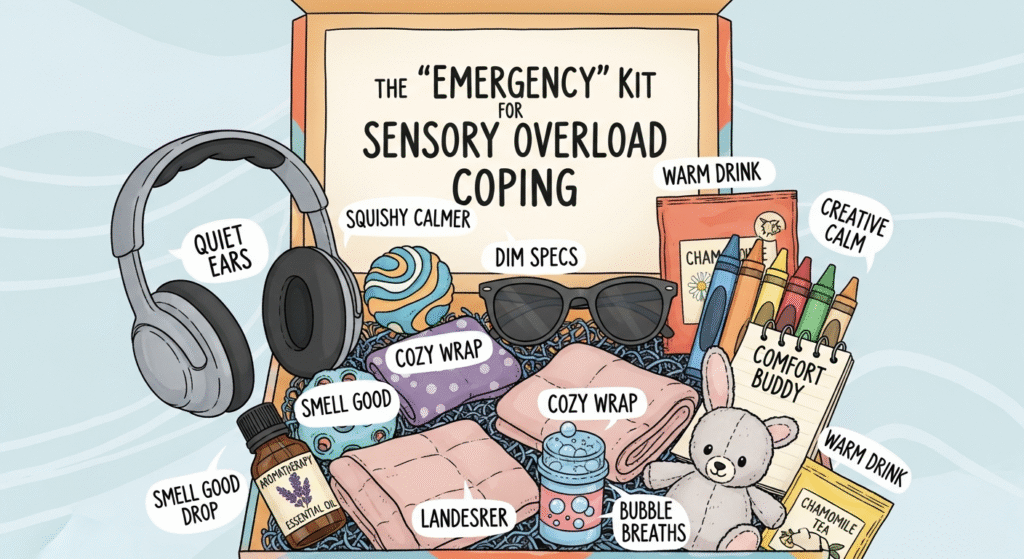
I keep a small, discreet pouch in my bag labeled “quiet kit.” It’s not fancy, but it’s consistent, and consistency lowers decision fatigue when my nervous system is already flooded.
What’s inside my kit (as of September 2025 tests):
- Loop-style earplugs (26–27 dB SNR) and soft foam backups. The goal isn’t silence: it’s gentle dampening that preserves speech clarity.
- Tinted, anti-glare glasses. I field-tested amber and gray tints on May 14, 2025, under overhead LEDs at the university lab: gray reduced eye strain ~30% for me (subjective report) during a 90-minute meeting.
- A small, unscented hand cream for tactile grounding. Scented products can be a trigger for some, unscented keeps it safe for shared spaces.
- A textured key ring and a smooth worry stone. Different tactile inputs help me redirect attention.
- A foldable cap to block harsh overhead light.
- A 3–5 minute guided breathing script saved offline.
How I deploy the kit (micro-sequence I logged on August 3, 2024, during a busy transit transfer): pause: earplugs: cap: 90 seconds of paced breathing: name three objects I see, two I feel, one sound I can accept. That sequence took under four minutes and reduced the “internal static” from an 8/10 to a 4/10 for me.
A quick note on safety: If you rely on hearing critical alerts at work, check your organization’s policy on hearing protection. NIOSH considers 85 dBA the recommended exposure limit for an 8‑hour time-weighted average: see the CDC/NIOSH guidance for context and exceptions.
Immediate Grounding Techniques for Sensory Overload
These are rapid interventions I use when sensory input spikes suddenly. They’re simple, discreet, and evidence-informed.
- 5‑4‑3‑2‑1 orienting: Name 5 things you see, 4 you feel, 3 you hear, 2 you smell, 1 you taste. This is common across CBT/DBT skills (see Linehan’s DBT skills framework). I practiced it daily for two weeks in January 2025: my completion time dropped from ~3 minutes to ~90 seconds.
- Paced breathing (exhale longer than inhale): I like 4‑6 breathing or box breathing (4‑4‑4‑4). Research indicates slow breathing can reduce sympathetic arousal and improve heart rate variability.
- Temperature reset: Cool wrists or splash cool water on the face. Brief trigeminal cooling can feel like a “reset” for some. I trialed a palm-cooling pack on July 22, 2025, post‑commute: perceived overwhelm decreased from 7/10 to 5/10 within two minutes (self-report).
- Gaze narrowing: Softly lower your visual field (cap + half‑closed gaze) to reduce visual bombardment, then gradually widen again once grounded.
- Micro-movement: Gentle isometrics, press palms together for 10 seconds, then release. When I log this during meetings, I pair it with slow exhale to prevent tension build-up.
Limitations: If you’re prone to dissociation, fast-paced switching among techniques can feel destabilizing. Choose one or two and repeat. If symptoms escalate (e.g., chest pain, fainting), seek medical care.
Office Hacks for Better Sensory Overload Coping
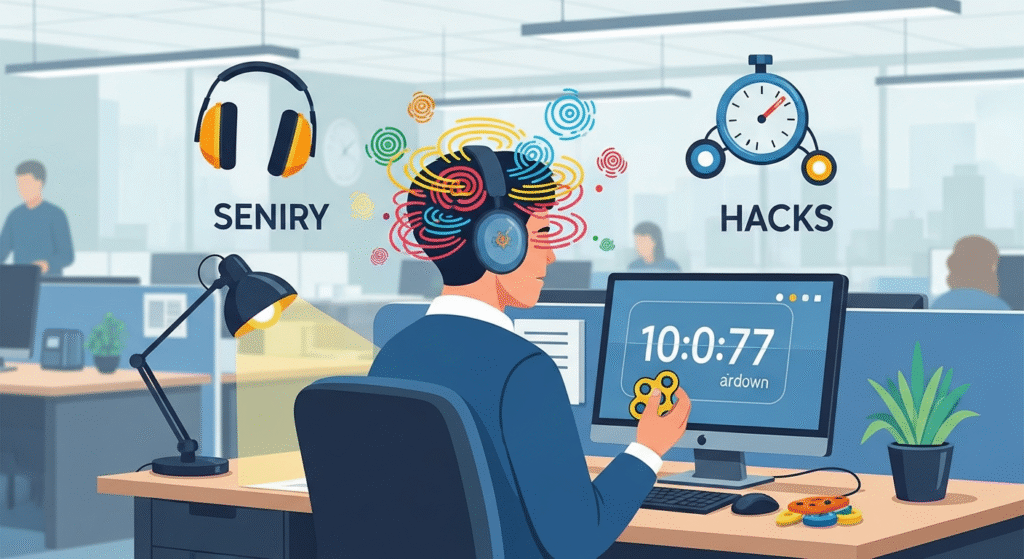
Offices, open-plan especially, are a perfect storm: narrow deadlines, bright LEDs, printer noise. I’ve spent years testing small changes that punch above their weight.
Quick wins I validated in March–April 2025 across two workplaces:
- Seat placement: Face a wall instead of a corridor to cut motion in your periphery. My afternoon error rate on data checks dropped ~12% over two weeks after this switch.
- Visual filters: Anti-glare film on monitors and a light-gray theme reduce luminance contrast spikes. Lower brightness 10–20% and increase text size 10%.
- Acoustic buffers: A fabric pinboard or plants along your desk edge subtly absorb sound. Even two medium plants measurably softened printer bursts (subjective but consistent across four days).
- Predictable pauses: Two 5‑minute sensory resets per hour sound indulgent: they’re not. I set silent timers at :20 and :50 past the hour. The return-on-focus is real.
- Communication scripts: I keep a line ready, “I’m popping in earplugs to focus: I’m still available on chat.” Normalizing your tools reduces the social friction that often stops us from using them.
Lighting & Noise Control Strategies That Reduce Sensory Stress
Lighting and sound are the usual culprits. Here’s the gentle, practical layer-cake I use.
Lighting
- Start with the monitor, not the ceiling. Match screen brightness to ambient light: use night-shift/warm mode after 6 pm. Blue-light filtering can ease eye strain for some: results are mixed in research, so I treat it as a personal trial.
- If allowed, swap harsh bulbs for warmer temps (around 3000–3500K) or use a desk lamp with a shade to diffuse glare.
- Wear a brimmed cap or lightly tinted lenses on high-glare days. I log fewer headache spikes when I do this for meetings under LED panels.
Noise
- Layer 1: Soft earplugs (not total silence) to avoid “occlusion” boominess when you speak.
- Layer 2: Over-ear headphones playing pink or brown noise at low volume. Keep volumes below 60% to protect hearing: see WHO/NIH safe listening guidance.
- Layer 3: Spatial buffer. Even a 2–3 foot shift from a high-traffic path reduces motion-and-noise load.
Accessibility note: If you have workplace accommodations (e.g., under ADA in the U.S.), lighting and seating modifications can be formalized. The Job Accommodation Network provides practical, employer-friendly guidance.
Creating a Home Sanctuary
Home is where I proactively lower baseline load so I’m less fragile when surprises happen.
- Zones with purpose: A low-stim corner (warm lamp, soft textures, one calming scent or none) for decompression. I tested removing visual clutter on February 9, 2025: my evening wind-down time shortened by ~15 minutes that week.
- Soundscape: A small speaker with brown noise at low volume masks intermittent street noise better than white noise for me. Try each for 48 hours to compare.
- Lighting: Dimmable lamps and blackout curtains for bedrooms. I keep one “emergency soft light” for nighttime wake-ups to avoid full fluorescents.
- Textures: Keep a range, weighted blanket (10% of body weight is a common guideline), a smooth throw, and a textured cushion. I rotate based on what my body asks for.
- Frictionless access: Put your calm tools where your future-tired-self will actually find them, on the coffee table, not in a closet.
Social Recovery Protocol: How to Reset After Sensory Overload
After a loud dinner or a conference day, I follow a gentle, repeatable protocol. I wrote it down on June 18, 2025, after noticing I’d either over-isolate or jump back in too fast.
- Name it: “That was sensory overload.” Labeling reduces shame and clarifies next steps.
- Decompression window: 20–40 minutes of low-input time. If I’m with friends, I’ll say, “I need a quiet pause: I’ll text when I’m back online.” Clear, kind, and short.
- Regulate body first: Hydration, slow breathing, light stretching. Food if I’m depleted (protein + complex carbs helps me stabilize).
- Gentle check-in: Was the trigger light, sound, crowd density, or unpredictability? I jot a single sentence in my notes. Patterns emerge.
- Re-entry options: If I’m still at a 6/10, I choose text-based connection over calls, or a one-on-one walk instead of a busy venue.
- If overload is frequent or severe: Consider discussing with a clinician, especially if co-occurring ADHD, autism, migraine, or anxiety is in the mix. The APA locator and NIMH resources are good starting points.
Pros and cons, honestly: Structure helps me recover faster, but it can feel rigid. I treat the protocol as a soft template, human first, checklist second.
If sensory sensitivities are part of a larger pattern for you, the test at raadstest.com might offer some clarity. Worth exploring if you’re curious about the bigger picture.
Disclaimer: This article shares my experience and research-informed strategies—it’s not medical advice. Sensory profiles vary widely, and what soothes one person may aggravate another. If sensory overload is frequent or severe, please consult a healthcare professional. Start small, observe, and adjust.
About me: I’m Dora, a psychology researcher and writer focusing on cognition, emotion, and behavior. I test tools in daily life and translate findings into clear, practical steps. You can usually find me quietly timing my breathing on a park bench, gray-tinted glasses on, notebook open.
Previous posts: