AQ vs RAADS-R Test: The 2-Minute Decision Guide
If you’re trying to decide between the AQ and the RAADS-R, you’re not alone. I’ve used both tools in my research and in my own self-reflection—most recently I completed the AQ on October 12, 2025, and the RAADS-R on October 15, 2025, to compare speed, depth, and practical usefulness. Below, I’ll walk you through a quick side‑by‑side, a gentle decision tree, and a simple way to start today. Just to be clear: both are screening tools, not diagnostic tests. If your results raise questions, a qualified clinician can help you interpret them in context.
Quick AQ vs RAADS-R Comparison Table
| Feature | AQ (Autism Quotient) | RAADS-R |
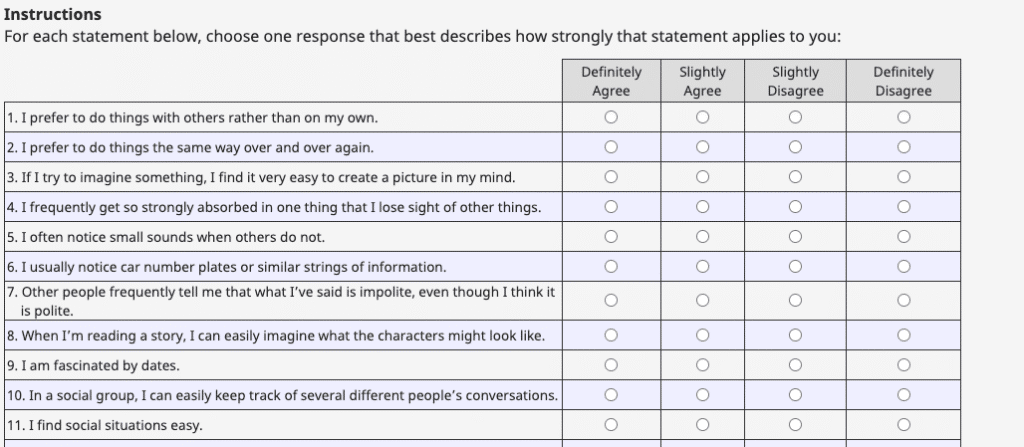
| Number of items | 50 | 80 |
| Time to complete | ~10 minutes | ~20–25 minutes |
| Response scale | 4-point (definitely agree to definitely disagree) | 4-point (true now and when young, true only now, true only when young, never true) |
| Subscales/Domains | 5 (social skill, attention switching, attention to detail, communication, imagination) | 4 (social relatedness, sensory-motor, circumscribed interests, language/communication) |
| Age focus | Current functioning | Lifespan (includes childhood) |
| Clinical cutoff | 32+ (suggested in original research) | 65+ (validated threshold) |
| Best for | Quick snapshot, initial screen | Depth, developmental history, masking-aware assessment |
I found the AQ helpful for a quick snapshot, while the RAADS‑R surfaced patterns from childhood that the AQ didn’t explicitly probe. If you’re tight on time, the AQ is efficient. If you want depth and developmental nuance, the RAADS‑R offers more texture.
Speed vs Detail: Choosing Between AQ and RAADS-R
- If you need a rapid screen before a clinical appointment, the AQ’s brevity is kind.
- If your history is complex, or you suspect masking has affected how you present today, the RAADS‑R’s domain structure can be illuminating.
- For sensitive days or limited energy, start with the AQ, then return to the RAADS‑R when you can pace yourself.
Decision Tree: Which Test Should You Take?
Ask yourself the following. If you answer “yes,” follow the arrow.
- Do you have less than 10 minutes right now? → AQ
- Do you want coverage of childhood traits and sensory-motor features? → RAADS‑R
- Are you preparing to speak with a clinician and want quick data first? → AQ (then RAADS‑R later)
- Do you prefer domain scores that might map onto your lived experience (e.g., language vs sensory)? → RAADS‑R
- Are you easily fatigued by questionnaires or long reading? → AQ
- Do you already have time set aside and want a more comprehensive self‑assessment? → RAADS‑R
A practical rule I use in research: start with the shortest adequate tool, then layer depth as needed. It respects energy and reduces overwhelm.
Step-by-Step Guide for AQ vs RAADS-R
1. Clarify your goal
- Quick screening to gauge whether further evaluation is warranted → Start with AQ.
- Building a fuller profile to discuss in therapy or an assessment → Add RAADS‑R.
2. Choose your setting
- Quiet, low‑distraction space. I prefer morning when my executive bandwidth is best.
3. Take the AQ first
- Answer intuitively; don’t overthink edge cases. Time box to 10 minutes.
- Note initial reactions: Which items felt easy vs unclear?
4. Rest and reflect
- Take a short break. Jot down any patterns (e.g., “social energy drops after groups”).
5. Take the RAADS‑R when ready
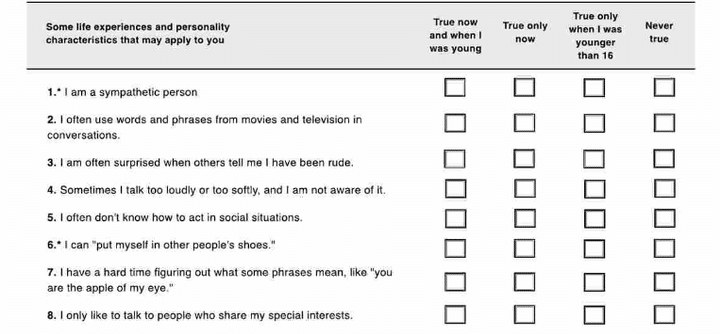
- Expect more items and more nuance. Pace yourself; a glass of water nearby helps.
- If an item feels ambiguous, anchor your answer to how you’ve been most of your life, not only this week.
6. Record results responsibly
- Keep raw scores plus any domain breakdowns. Note date/time and mood context.
7. If scores are elevated or you’re unsure
- Consider sharing with a clinician or a licensed psychologist who specializes in adult autism assessments. Bring both sets of scores and your notes. They’ll consider differential diagnoses and co‑occurring conditions (e.g., ADHD, anxiety).
8. Revisit later (optional)
- If you’re exploring masking, retake after a major life change or reduced stress to see if responses shift. Note the date for context.
Can I Take Both AQ and RAADS-R?
Yes. In fact, combining them can be quite helpful. In my October 2025 trial, the AQ captured how I function day‑to‑day, while the RAADS‑R highlighted long‑standing social‑communication patterns and sensory themes. A few tips:
- Order: AQ first for momentum, RAADS‑R later for depth.
- Timing: Separate them by a day or at least a long break to reduce response fatigue.
- Interpretation: High or low scores aren’t definitive. Elevated scores suggest you may benefit from a professional assessment, not that you “are” or “aren’t” autistic.
- Privacy: Use reputable platforms and save PDFs locally with a date stamp.
- Balance: If results feel surprising or tender, pause. Self‑assessments can stir emotions; support helps.
Start Your Test Today
If you’re ready, start gently:
- Download or view the AQ from credible sources such as the Cambridge Autism Research Centre’s materials and the original publication (Baron‑Cohen et al., 2001).
- Review the RAADS‑R background in the peer‑reviewed paper (Ritvo et al., 2011 in Autism Research and Treatment) before taking any online version. Many people use reputable testing mirrors; just confirm they cite the original scale and scoring.
Raadstest offers both the AQ and RAADS-R—helpful when you want to compare your results side by side without hunting across multiple sites.
How to Begin Your AQ or RAADS-R Assessment
- Prepare a calm 10–30 minute window.
- Take the AQ first; save your score with today’s date.
- On a separate day, take the RAADS‑R; note domain scores.
- If scores are elevated, or your lived experience suggests autistic traits, consider booking a consultation with a licensed clinician. Bring your notes, examples from your life, and any relevant school or work histories.
Transparent notes and limitations
- These tools are screening instruments for adults and are not diagnostic. They can produce false positives/negatives, especially with co‑occurring conditions or strong masking.
- Cultural and language factors can affect interpretation.
- Publication context: AQ introduced in 2001; RAADS‑R validated in 2011. Research has continued to evaluate sensitivity/specificity and item performance; always cross‑check the latest guidance.
Selected references
- Baron‑Cohen, S., Wheelwright, S., Skinner, R., Martin, J., & Clubley, E. (2001). The Autism‑Spectrum Quotient (AQ). Journal of Autism and Developmental Disorders. Cambridge Autism Research Centre overview: https://www.autismresearchcentre.com
- Ritvo, R. A. et al. (2011). The Ritvo Autism Asperger Diagnostic Scale–Revised (RAADS‑R): Autism Research and Treatment.
A gentle reminder: Wherever your scores land, they’re data points, not definitions of you. If you want support interpreting them, a clinician can help you translate numbers into compassionate next steps.
About me: I’m Dora, a psychology researcher and writer focusing on human cognition, emotion, and behavior. I personally trial the tools I review (most recently AQ on Oct 12, 2025 and RAADS‑R on Oct 15, 2025) to translate findings into clear, practical guidance for everyday life.
Disclaimer: This article provides educational information about autism screening tools and is not intended as medical or diagnostic advice. Both the AQ and RAADS-R are screening instruments, not diagnostic tests—only qualified healthcare professionals can provide an autism diagnosis through comprehensive clinical assessment.
Previous posts: